Best Stationery Items for Students: A Complete School Supplies Checklist
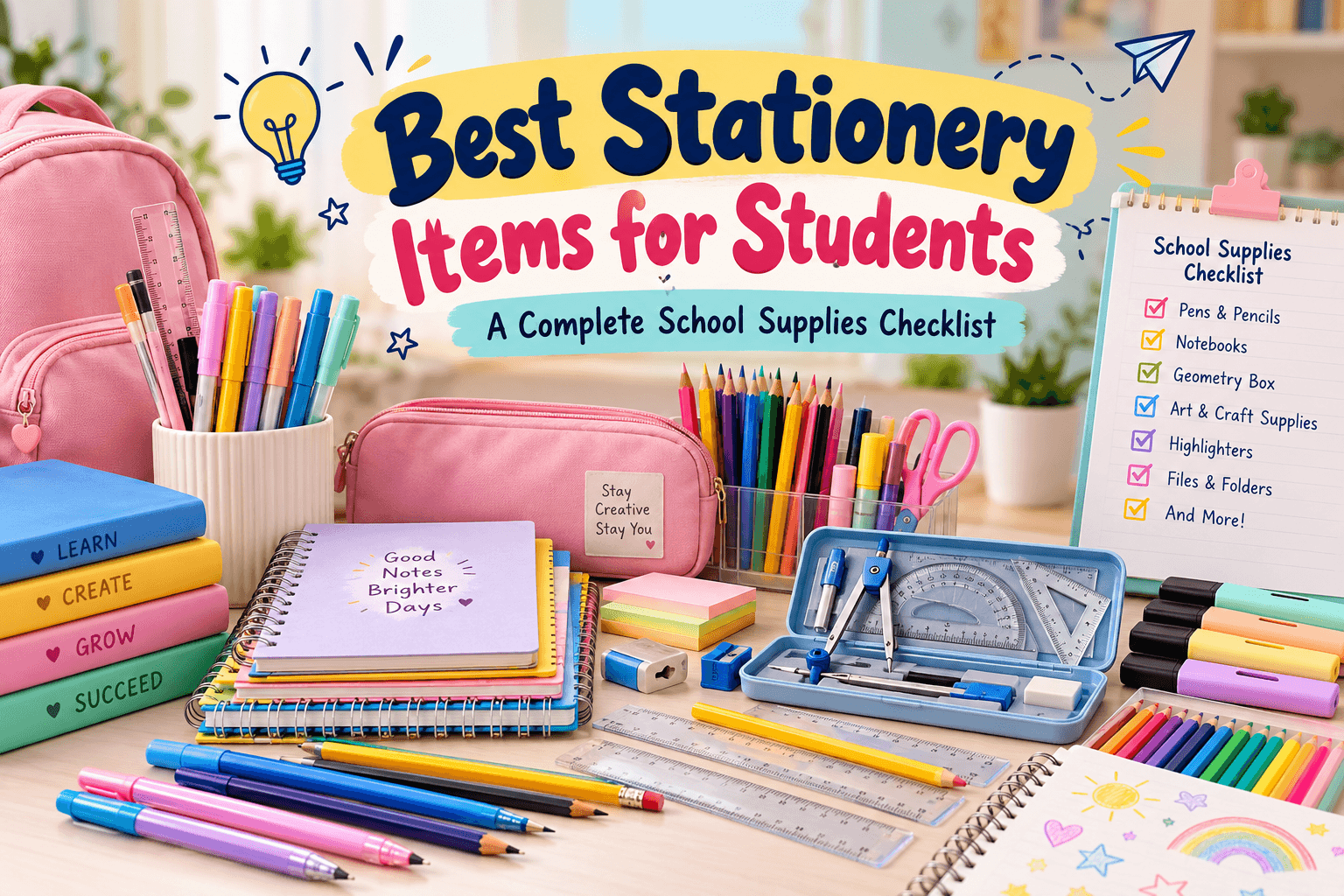
Best Stationery Items for Students: A Complete School Supplies Checklist
Choosing the best stationery items for students is an important part of preparing for a successful school year. From everyday writing essentials to creative art supplies, the right school stationery helps students stay organised, complete assignments efficiently, and develop better study habits.
However, with so many stationery products available, parents often wonder what their children actually need. Should they buy a complete stationery set or individual items? Which school supplies are essential for younger students? What stationery should students carry for mathematics, drawing, examinations, and school projects?
This comprehensive school supplies checklist answers these questions and helps parents, students, and teachers choose the most useful stationery items without unnecessary spending.
Whether you are preparing for a new academic session or restocking everyday school supplies, this guide covers the essential stationery items for students from primary school to higher classes.
Table of Contents
Why Are Stationery Items Important for Students?
Best Stationery Items for Students: Essential Checklist
School Stationery Checklist by Class
Art and Craft Stationery for School Projects
Best Stationery Items for Exam Preparation
How to Choose the Right School Supplies
Tips to Organise School Stationery
Common Mistakes to Avoid When Buying Stationery
Frequently Asked Questions
Conclusion

1. Why Are Stationery Items Important for Students?
Stationery is more than just a collection of pens, pencils, and notebooks. It supports everyday learning, helps students organise their work, and makes classroom activities more convenient.
Having the right stationery items for school can help students:
Improve handwriting: Suitable pencils, pens, and notebooks make regular writing practice easier.
Stay organised: Subject-wise notebooks, folders, and pencil pouches help keep schoolwork organised.
Complete assignments efficiently: Essential writing and measuring tools allow students to complete their work without interruptions.
Encourage creativity: Colour pencils, sketch pens, drawing books, and craft materials support creative activities.
Prepare for examinations: Highlighters, revision notebooks, rulers, and other study supplies help students organise revision materials.
Develop independent habits: Keeping stationery in the right place encourages responsibility and better study routines.
The key is to select school stationery according to the student's age, class, subjects, and school requirements.
2. Best Stationery Items for Students: Essential Checklist
If you are searching for a complete stationery items list for students, start with the following essentials. Most students will need at least some of these supplies for daily classroom activities, homework, and projects.
1. Pens
Pens are among the most essential stationery items for students, particularly those in middle school and higher classes.
Students may need different pens for everyday writing, note-taking, assignments, and examinations.
Recommended options include:
Blue ballpoint pens for everyday writing
Black pens where required by the school
Gel pens for students who prefer smoother writing
Red or other coloured pens for specific note-taking tasks, where permitted
Extra pens or refills to avoid running out during the school day
When selecting the best pens for students, prioritise comfortable grip, consistent ink flow, and easy handling rather than appearance alone.
2. Pencils
Pencils are essential school supplies for younger children, mathematics exercises, diagrams, rough work, and drawing activities.
HB pencils are a practical choice for general writing and schoolwork. Students who regularly draw or sketch may also need pencils with different grades, depending on their requirements.
What to include in a student's stationery kit:
HB writing pencils
A few spare pencils
Drawing pencils, if required
Mechanical pencils for older students, if preferred
For younger children, choose pencils that are easy to grip and comfortable to use during handwriting practice.
3. Erasers
An eraser is a basic but indispensable stationery item. Students use it to correct pencil mistakes, clean up diagrams, and improve the neatness of their written work.
Choose a soft eraser that removes pencil marks without damaging the paper. Keeping an extra eraser in the school bag can also be helpful.
4. Pencil Sharpeners
A pencil sharpener helps students maintain a suitable pencil point for writing, drawing, and completing school assignments.
A compact sharpener with a shaving container is particularly useful for school bags because it reduces mess and makes cleaning up easier.
When buying a pencil sharpener for students, consider its durability, ease of use, and suitability for the pencil size.
5. Notebooks and Registers
Notebooks are among the most frequently used school stationery products. Students use them for class notes, homework, written exercises, practical work, and revision.
The types of notebooks required depend on the student's class and the school's instructions.
Common options include:
Ruled notebooks for language subjects and general notes
Four-line notebooks for early handwriting practice
Square-ruled notebooks for mathematics
Practical notebooks for science and other practical subjects
Drawing books for art activities
Rough notebooks for calculations and practice
Revision notebooks for summarising important concepts
Buying tip: Check the required page count, notebook size, ruling, and binding before purchasing. Buying the wrong notebook format can lead to unnecessary expenses.
6. Pencil Box or Pencil Pouch
A pencil box or pencil pouch helps students keep their writing tools in one place. It reduces the chances of losing small items and makes it easier to find stationery during lessons.
A pencil box with compartments can be useful for younger children, while older students may prefer a lightweight pouch.
Popular choices include:
Compact pencil boxes
Multi-compartment pencil cases
Zippered pencil pouches
Character-themed pencil boxes
Lightweight stationery pouches
When choosing a pencil box for school, consider storage capacity, durability, ease of cleaning, and the amount of stationery the student actually carries.
7. Ruler or Scale
A ruler is an essential stationery item for drawing straight lines, measuring lengths, making tables, and completing mathematics exercises.
A 15 cm ruler may be sufficient for younger students, while older students may need a 30 cm ruler, depending on their subjects and school requirements.
Choose a ruler with clear measurement markings that are easy to read.
8. Geometry Box
A geometry box is an important addition to the school stationery checklist for students studying mathematics and geometry.
A typical geometry box may include:
Compass
Divider
Protractor
Set squares
Small ruler
Pencil and other mathematical tools, depending on the set
Before buying a geometry box, check the contents and ensure that the instruments are suitable for the student's class.
Students should also learn to store these instruments safely and keep the box organised.
9. Highlighters
Highlighters can be useful for older school students and college students who need to organise notes and revision materials.
They help draw attention to important definitions, formulas, dates, keywords, and concepts.
Common options include yellow, green, pink, blue, and pastel highlighters.
However, highlighting every line can make notes harder to review. Students should use highlighters selectively to identify the most important information.
10. Correction Tape or Correction Pen
Correction products can help students correct writing mistakes neatly, subject to their school's rules.
Correction tape is often convenient because it dries immediately, while correction pens may suit particular writing or paper requirements.
Students should check whether correction products are permitted during examinations before carrying them into an exam hall.
11. Sticky Notes and Page Markers
Sticky notes and page markers are useful stationery accessories for organising revision, marking important pages, and writing short reminders.
Students can use them to:
Mark chapters that require revision
Note homework deadlines
Record important formulas
Flag difficult questions
Create quick reminders for assignments
These items are especially useful for students who maintain structured study notes or revision plans.
12. Files and Folders
Files and folders help students store worksheets, printed assignments, certificates, loose papers, and project documents.
A simple folder can prevent important papers from getting folded, damaged, or misplaced inside a school bag.
Older students may benefit from separate folders for different subjects, while younger students may only need one folder for worksheets and notices.
3. School Stationery Checklist by Class
Not every student needs the same stationery items. A nursery student has different requirements from a Class 10 student, so the best approach is to customise the school supplies list according to the child's grade.
Nursery, Kindergarten, and Pre-Primary
For younger children, choose simple, age-appropriate stationery that supports early learning and creative activities.
Suggested checklist:
Thick or easy-grip pencils, if required
Child-friendly eraser
Pencil sharpener with a container
Crayons
Washable colour pencils or sketch pens, as requested
Drawing book
Required handwriting or activity notebooks
Pencil pouch
Glue stick and child-safe scissors, where supervised and permitted
Avoid buying sharp or complicated tools that young children do not need.
Classes 1 to 3
Students in the early primary classes often need stationery for handwriting practice, basic mathematics, colouring, and classroom assignments.
Suggested checklist:
HB pencils
Erasers and sharpeners
Ruled or four-line notebooks, as specified
Mathematics notebook
Drawing book
Crayons or colour pencils
Ruler
Pencil box
Glue stick
Child-appropriate craft supplies
At this stage, comfortable writing tools and simple organisation are more important than an oversized stationery collection.
Classes 4 to 7
As students progress through primary and middle school, their school stationery requirements become more varied.
Suggested checklist:
Blue pens, where permitted
Pencils, erasers, and sharpeners
Subject-wise notebooks
Mathematics notebook
Ruler
Geometry box, when required
Colour pencils or sketch pens for projects
Highlighters
Files and folders
Glue stick and scissors for assignments
Students should also start organising notebooks and keeping track of their supplies independently.
Classes 8 to 10
Students in higher classes often need stationery for detailed notes, diagrams, mathematics, science practicals, and examination preparation.
Suggested checklist:
Blue and black pens, according to school rules
Spare pens and pencils
Subject-wise notebooks
Practical notebooks, where required
Geometry box
Ruler and mathematical instruments
Highlighters
Correction products, if permitted
Sticky notes and page markers
Project files and folders
Graph paper or other subject-specific supplies, if required
Students preparing for board examinations should pay particular attention to their school's and examination board's rules regarding permitted writing instruments and other materials.
Classes 11 and 12
Senior secondary students may require different stationery depending on their academic stream and subjects.
Suggested checklist:
Pens and spare refills
Notebooks or registers for each subject
Revision notebook
Highlighters and sticky notes
Geometry box and ruler, where needed
Practical files and record books
Graph paper, where applicable
Subject-specific stationery
Folders for worksheets, assignments, and notes
Students should prioritise functional stationery that supports regular study and revision.
4. Art and Craft Stationery for School Projects
Art and craft supplies are important for drawing lessons, creative assignments, charts, presentations, and school exhibitions.
If you are preparing a school stationery shopping list, consider adding the following items when required by the school.
Colour Pencils
Colour pencils are useful for colouring diagrams, maps, illustrations, and school projects. A basic set can be sufficient for everyday classroom activities.
Crayons
Crayons are commonly used by younger children for colouring exercises and creative activities. Choose products designed for the intended age group.
Sketch Pens and Markers
Sketch pens are useful for colouring, labelling, and decorating charts. Markers may be required for posters and presentations, depending on the project instructions.
Drawing Paper and Chart Paper
Drawing sheets and chart paper are useful for art assignments, diagrams, presentations, and classroom displays.
Buy the size and paper type specified by the teacher rather than purchasing large quantities without a clear requirement.
Glue Sticks and Adhesives
Glue sticks help students attach paper, pictures, and lightweight craft materials. They are convenient for many classroom projects.
Choose an age-appropriate adhesive and follow the school's safety instructions.
Scissors
Scissors are used for cutting paper and craft materials. Younger children should use suitable child-safe scissors under adult supervision.
Washi Tape and Decorative Stationery
Decorative stationery, including washi tape, can make journals, planners, project covers, and creative assignments more visually appealing.
Students can use decorative stationery for personalisation, but it should complement the work rather than distract from the assignment's requirements.
5. Best Stationery Items for Exam Preparation
Exam preparation requires more than writing materials. Students also need tools that help them organise revision, practise questions, and manage their study schedules.
Useful stationery items for exam preparation include:
Blue or black pens permitted by the examination rules
Spare pens
Pencils and erasers
Ruler and geometry box, where applicable
Revision notebooks
Highlighters
Sticky notes and page markers
Subject-wise files
A planner or study diary
How to Build an Effective Revision Stationery Kit
Start by keeping all revision materials in one designated place. Use separate notebooks or clearly labelled sections for each subject.
Highlight only essential concepts, maintain a list of topics that need further practice, and use sticky notes for short reminders.
Students should also prepare their permitted examination materials in advance. Always follow the official instructions for the specific examination instead of assuming that every stationery item is allowed.
6. How to Choose the Right School Supplies
Finding the best stationery for students does not mean buying the most expensive products or the largest stationery set. It means choosing products that match the student's needs.
1. Check the School's Stationery List
Before buying school supplies, review the list issued by the school. Requirements can vary by class, subject, teacher, and academic session.
This simple step helps avoid buying duplicate or unnecessary products.
2. Prioritise Quality and Comfort
Students use some stationery items every day. Comfortable pens, pencils that sharpen properly, durable rulers, and notebooks with suitable paper can make everyday schoolwork easier.
Look for practical features rather than relying only on product appearance.
3. Choose Age-Appropriate Products
Younger students usually benefit from simple writing tools, easy-to-open pencil boxes, and suitable colouring materials.
Older students may prefer compact pouches, highlighters, geometry tools, and more subject-specific stationery.
4. Consider Storage and Portability
A large stationery set may appear convenient, but carrying too many items can make a school bag unnecessarily heavy.
Choose a pencil pouch or pencil box that fits the essential supplies without taking up excessive space.
5. Compare Individual Items and Stationery Sets
A stationery set can be a convenient option when several basic items are needed together. However, not every set contains the exact products required by the school.
Compare the contents, quality, quantity, and total cost before deciding whether to buy a set or individual products.
6. Check Product Details When Shopping Online
When buying stationery online, review the product description carefully.
Check dimensions, pack quantity, material, design variations, and the items included in a set. Also review delivery information and the seller's applicable return policy.
These details help you make an informed purchase and reduce the chances of ordering the wrong product.
7. Tips to Organise School Stationery
An organised stationery collection saves time and makes school preparation easier.
Here are some practical tips for students and parents.
Keep everyday items together. Pens, pencils, erasers, sharpeners, and rulers should be stored in a pencil box or pouch.
Label notebooks and files. Write the subject name clearly on each notebook to make it easier to find the right one.
Store art supplies separately. Keep crayons, colour pencils, glue, and other project materials in a separate container at home.
Maintain a small reserve. Store spare pens, pencils, erasers, and other frequently used supplies at home so that replacements are available when needed.
Check the school bag regularly. Remove unnecessary papers, sharpen pencils, check pen ink, and replace missing supplies.
Reuse stationery where possible. Inspect last year's supplies before buying replacements. Usable rulers, geometry boxes, pencil pouches, and other durable products may not need to be replaced every year.
8. Common Mistakes to Avoid When Buying Stationery
Even a detailed school supplies checklist can lead to unnecessary purchases if you do not consider the student's actual requirements.
Avoid these common mistakes:
Buying everything at once: Some stationery items may only be needed later in the academic year.
Ignoring school instructions: Incorrect notebook ruling, size, or permitted writing tools can lead to avoidable expenses.
Choosing appearance over usability: Attractive stationery is useful only when it is practical and comfortable.
Buying too many decorative products: Washi tapes, stickers, and colourful pens are optional unless specifically required.
Overlooking product specifications: Always check pack sizes and included items before buying online.
Discarding usable supplies: Reusing functional stationery can reduce waste and save money.
Overfilling the school bag: Carry only what the student needs for the day's classes.
A practical approach is to purchase essential stationery first and add specialised items as school requirements arise.
9. Frequently Asked Questions
Q1. What are the most important stationery items for students?
The most important stationery items for students generally include pens, pencils, erasers, sharpeners, notebooks, a ruler, and a pencil box or pouch. Depending on their class and subjects, students may also need a geometry box, highlighters, files, drawing materials, and craft supplies.
Q2. What should be included in a complete school supplies checklist?
A complete school supplies checklist should cover writing tools, notebooks, mathematical instruments, storage accessories, and art materials where required. The final list should follow the school's instructions and the student's class requirements.
Q3. Which stationery items are best for primary school students?
Primary school students generally need pencils, erasers, sharpeners, suitable notebooks, rulers, pencil boxes, drawing books, and colouring supplies. Younger children may also need glue sticks and child-safe scissors for supervised craft activities.
Q4. What stationery do students need for higher classes?
Students in higher classes may need blue and black pens, subject-wise notebooks, practical files, highlighters, geometry boxes, graph paper, and revision materials. The exact list depends on their subjects and examination requirements.
Q5. Is it better to buy a stationery set or individual items?
A stationery set is convenient when it includes several products that a student needs. Buying individual items may be more practical when the school has specific requirements or the student already owns some supplies. Compare the contents and total cost before deciding.
Q6. How can parents save money when buying school stationery?
Parents can save money by checking the school's list, reusing functional supplies, comparing pack sizes, and buying multipacks only for frequently used items. Purchasing stationery in stages can also help avoid spending on products that may not be needed.
Q7. What stationery items help students stay organised?
Pencil pouches, subject-wise notebooks, labelled folders, sticky notes, page markers, and study planners can help students keep their materials organised. Simple storage habits are often more useful than buying too many accessories.
Q8. Which stationery items are useful for school projects?
Common project supplies include drawing paper, chart paper, colour pencils, sketch pens, rulers, glue sticks, scissors, and folders. Students should check their teacher's instructions before purchasing project materials.
Q9. How often should students replace their stationery?
Frequently used items, such as pens and pencils, should be replaced when they run out or become unusable. Notebooks can be replaced when they are full, while durable products such as rulers, pencil boxes, and geometry boxes can be reused as long as they remain in good condition.
Q10. What should parents check before buying stationery online?
Parents should verify product dimensions, material, pack quantity, included items, delivery timelines, and applicable return conditions. They should also ensure that the stationery is suitable for the child's age and school requirements.
10. Conclusion
Choosing the best stationery items for students becomes much easier when you have a clear school supplies checklist. From pens, pencils, and notebooks to geometry boxes, drawing materials, and organisational accessories, every item should serve a practical purpose.
The best stationery collection is not necessarily the biggest one. It is the collection that helps students write comfortably, keep their work organised, complete assignments, and prepare for examinations without unnecessary distractions.
Before starting a new academic session, review the school's stationery requirements, check which supplies are already available at home, and purchase only the items that are missing or need replacement.
With the right stationery and a simple organisation routine, students can start the school year feeling prepared and confident.
Explore Cursive Letters for stationery, notebooks, highlighters, sharpeners, pencil pouches, drawing materials, and other useful everyday essentials. Choose practical products that suit your requirements and make school preparation simpler.