Growth of the Stationery and Toys Segment in India Over the Past Decade
How big are these markets?
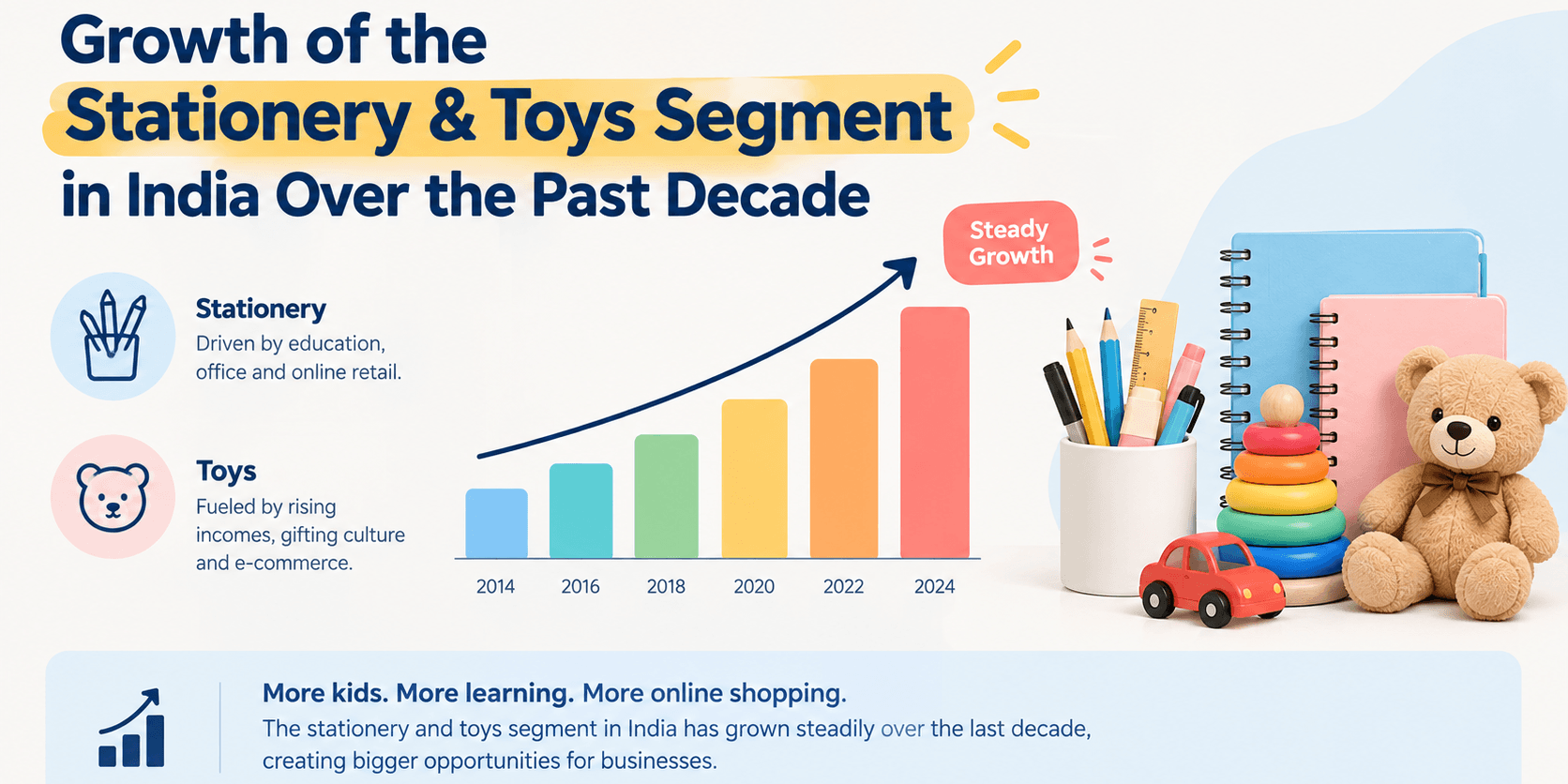
The estimation of the toy market varies according to the method of calculating the figures between $2.1 billion to $6.5 billion. The growth rate is around 7% to 12% CAGR till the beginning of the 2030s (as per IMARC, Credence Research, Market Research Future). Only a decade ago in the late 2010s, India had less than 1% share of the global toy market (as per IBEF). The stationery market estimates range from $2.6 billion to $6.8 billion with a growth rate between 5% to 13% (according to the respective market research company) and with a strong base of around 24.7 crore school-going children in India (udise+ 2025-26). The revenue of DOMS Industries increased from ₹654 crore FY20 to ₹1,212 crore FY23, with a growth rate at a CAGR of 23%, surpassing competitors Linc, Kokuyo Camlin, Flair, and Navneet in the stationery market. The country exports about $165 million worth of ballpoint pens every year, growing from Rajkot’s first pen factory, established in 1962.
{Source : https://www.imarcgroup.com/indian-toys-market }
The policy shift that changed everything
Four moves reshaped this decade and reshaped the economics of being an importer or wholesaler in this space:
1. Customs duty hikes — Basic Customs Duty on toys (HS 9503) rose from 20% to 60% in February 2020, then to 70% in March 2023. For anyone weighing whether to become a direct importer from China, this single change is the reason landed cost math looks completely different today than it did a decade ago.
2. Toys (Quality Control) Order, 2020 — effective January 1, 2021, it made BIS/ISI certification compulsory (IS 9873 for non-electric toys, IS 15644 for electric toys). Quality conformance jumped from just 33% of toys tested in 2019 to 95% in 2025. Crucially, BIS licences are granted only to manufacturers, not to traders — so an imported stationery wholesaler or toy trader can't self-certify; they depend entirely on their overseas supplier already holding valid BIS approval.
3. DGFT mandatory sample testing of every toy import consignment, adding a border-level check against substandard shipments — and real time/cost to customs clearance for any stationery importer.
4. GST 2.0 (September 2025) — toys cut from 12% to 5%; notebooks, pencils, erasers, and crayons moved to 0%; pens remain at 18%.
{Source: https://www.pib.gov.in/PressReleasePage.aspx?PRID=1993109®=48&lang=2 }
India's trade agreements with the UAE, Australia, EFTA, Oman, New Zealand, and the UK provide complete exemption from customs for toy exporters, and over 2,200 exporters have availed of the RoDTEP duty exemption scheme. These measures have resulted in a decline of China's share in India's toy imports from around 87% (FY19) to 64% (FY24).

Winners and strugglers: MSMEs vs. large manufacturers
Around 90% of the informal toy sector is represented by MSMEs, which suggests that there are around 4,000 MSME manufacturers employing three million workers — 70% of whom are women. The micro-enterprises benefit from fee exemptions from BIS (up to 80%), a waiver that allows them to get a license without having to set up a testing lab, and 18 toy clusters under SFURTI. However, it is emphasized that the labs are largely located in big cities, which poses obstacles in logistics for manufacturers located in small towns, while industry players warn that an abrupt enforcement of QCO can result in blocking of working capital even in the case of compliant businesses.
{ Source : https://www.civilsdaily.com/epw-indias-toy-industry-summary/ }
Larger, established manufacturers are obtaining their fair share of the benefits. A precision manufacturing corporation called Aequs is putting in an investment of around $500 million into a toy cluster that spans 400 acres in Koppal, Karnataka. Aequs already supplies global companies like Hasbro, Spin Master, and Chicco. A toy PLI scheme (worth ₹13,000 crore) is being discussed, although it has not been approved by the Cabinet yet.
While big corporations are thriving in this new scenario, traders and importers are facing extreme difficulties. Increasing duties coupled with consignment-based testing have compelled many of them to move away from the traditional import and resale mode of doing work and switch to more profitable wholesale stationery supply or mass supply of domestically made and the Bureau of Indian Standards-certified products.
{Source : https://www.researchgate.net/publication/357758935_Opportunities_and_Challenges_of_Toy_Manufacturing_Sector_in_India }
{ https://www.karparivartan.com/bis-fee-structure-in-india-minimum-marking-fee-msme-discounts-explained/ }
What this means if you supply online sellers
This shift is especially relevant if you're a supplier for online sellers or a Meesho, Amazon, or Flipkart supplier. Online retail already accounts for roughly 38% of India's toy market by value, and marketplace sellers are constantly sourcing bulk stock — but three things have changed the sourcing calculus:
● Toys need a BIS/ISI mark to be sold legally — a marketplace seller stocking uncertified imported toys risks listing takedowns and stock seizure, so any supplier you work with should be able to show valid BIS documentation.
● GST classification affects margins — toys at 5%, most core stationery at nil, pens at 18%; getting this wrong on marketplace listings creates compliance headaches at scale.
● Domestic bulk supply is often more reliable than import — with China's import share falling and duties at 70% on finished toys, many Meesho/Amazon/Flipkart sellers now find it cheaper and faster to buy from an established domestic wholesale stationery supplier or bulk supplier in India than to import directly, especially for smaller order volumes where customs delays eat into margins.
Real examples
● Channapatna, Karnataka — a GI-tagged, 3,000-artisan wooden-toy cluster dating back two centuries, still squeezed by cheap replicas despite its GI protection.
● Koppal, Karnataka — Aequs's export-focused SEZ, projected to create 25,000 direct and 100,000 indirect jobs.
● DOMS Industries — IPO-backed (₹1,200 crore raised, December 2023), now holds 12% of the branded stationery market and 29% of the pencil market.
● Flair Writing Industries — ₹943 crore revenue, ₹110 crore profit (FY23), now expanding pen-export capacity in Gujarat.
● PlayShifu, Smartivity, Shumee — D2C STEM-toy startups; over 700 toy startups are now Startup India-recognised.
What's next
DPIIT established a SCALE task force in July 2026 with the aim of capturing a 5% share of the global toy market by 2032 from the current share of less than 1%. But not everything has gone as planned — an analysis by GTRI shows that exports remained stagnant over FY22 to FY24, reminding that the mere presence of import restrictions cannot guarantee export competitiveness. Factors such as investments in clusters, free-trade agreements, and improvements in logistics (while cargo clearance takes only 1-2 days in Vietnam, it still takes between 4-6 days at Indian ports) are equally important.
Summary
The toy and stationery sectors in India have transformed from being reliant on imports to becoming increasingly self-sufficient and export-driven in the past decade. For wholesale suppliers of stationery or stationery importers or suppliers catering to e-commerce entities on platforms like Meesho, Amazon, and Flipkart, the key takeaway has remained consistent — the scenario of importing toys easily from China is nearing an end with the relevant duty in the ballpark of 70%, while the need to rely on domestic stakeholders for bulk supply of stationery in India — sourcing products from BIS-certified suppliers and organized players in the stationery business across segments.
Sources: Ministry of Commerce and Industry (PIB, response from Lok Sabha, July 2026), IBEF, IMARC, Credence Research, GTRI, IPO prospectus of DOMS Industries, IPO filings of Flair Writing Industries, 56th meeting outcomes from GST council.